Showing posts with label Books. Show all posts

Friday, January 13, 2012

New Book, From The Minds of Madness: The Origins of Heavy Metal Band Names, by Blair Gibson

This is a first for B.A.N. while we have done a few book reviews this is the first time we've plugged a newly released book. Check it out.

As of the 6th of January, the new book "From The Minds of Madness: The Origins of Heavy Metal Band Names" by Blair Gibson is out. This book is a compilation of testimony from members of over 350 bands, about the origin of the name of their band. The bands come from all corners of the heavy music spectrum, including B.A.N. favourites Yawning Man, Whores of Tijuana, Truckfighters and Totimoshi. Awesome idea and a nice H.P. Lovecraft reference in the title. We hope this book gets the ball rolling for Blair. Cheers!

Pick up your ebook copy of it here: http://www.smashwords.com/books/view/120088

Edward Gerard Brophy
bornagainnihilist@gmail(dot)com.

Thursday, August 25, 2011

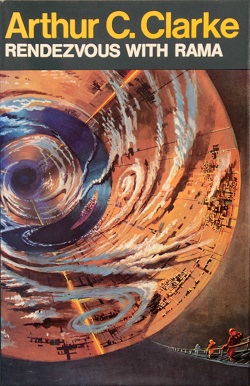
Book Review, 'Rendezvous With Rama' by Arthur C. Clarke

Arthur C. Clarke. In the sci-fi history books (of which there are one or two believe it or not) he is regarded as a creative genius and something of a prophet. Recently I got the opportunity to delve into his universe with the critically acclaimed 1972 novel ‘Rendezvous with Rama’.


As is the case with most people, my first introduction to Clarke was being shown the film ‘2001 A Space Odyssey’ when I was young…and not understanding it one bit. However, I think it’s true to say that those experiences often stick in your head the most and breed a certain curiosity in you. So, after breaking into the Isaac Asimov universe with ‘Foundation’, I now took on Arthur C. Clark. I spent the first half of the reading of Rama thinking that it was the book on which ‘2001’ was based. Where I got that information, I have no idea but thanks to Rob Agar and his in-depth film analyses, I found out that it was in fact a book called ‘The Sentinel’  which inspired ‘2001’.


See his brilliant analysis of the Monolith in 2001 here:


The story so far: We find ourselves with an omniscient narrator in the year 2130 and some foreign object has entered the solar system. As time goes on, astronomers who keep an eye on the approaching object begin to discern that this is something that cannot be of anything but intelligent origin. The object of speculation is a gigantic cylinder, some 50 kilometres long by 16 wide and perfectly smooth. The story revolves around the crew of the spaceship Endeavour who are sent to rendezvous with the object, named Rama after an avatar of Vishnu. Another prophecy of Clarke’s is that the Pantheon of Greek and Roman gods have all been used to name planets and asteroids so astronomers have moved onto the Hindu collection. What the crew of Endeavour discovers upon arrival is beyond belief: the cylinder is hollow (remember the world sized ring from the first Halo game?) and once they eventually find there way inside they discover, amongst many other things, the spin of the object creates a small artificial gravity. They resolve to explore the interior as best they can before Rama passes too close to the sun for conditions to be safe.


The book, which is split into many small chapters, each dealing with a certain subject or event, takes us through technicalities, future interplanetary political strife (Mars, the Moon and even Mercury has been colonised and have separate governments) and so much visual science fiction wonderment. Clarke’s power as a writer is not in creating poetry like Herman Melville, or perplexing characters like Asimov (that sort of sounds like I’m name dropping but whatever), his strength is the pure invention: you believe that everything he writes is possible, and in some cases, even likely! It’s no surprise that he is called a sci fi prophet, he would probably still be considered so even if he had never written about satellites in orbit as early as the 1940’s:


“He described this concept in a paper titled "Extra-Terrestrial Relays — Can Rocket Stations Give Worldwide Radio Coverage?", published in 'Wireless World' in October 1945.” (Wikipedia)

This is a truly great work of sci fi, and of speculative fiction on the whole. It stands the test of time by remaining ahead of the game still, and it is barely dated, even in the language used. As with most great works of the genre, a film adaptation is (kind of) in the works, due for some time in 2013, but with no script it is unlikely to see the light of day that soon…but you never know.


Anyway, this blogger has got himself a second hand copy of the sequel, ‘Rama II’ and after a successful completion of Kurt Vonnegut’s ‘Mother Night’, (thanks Steve) I’m getting well into that!


‘Rendezvous With Rama’ by Arthur C. Clarke.
Rating: 9/10
By Edward Gerard Brophy for Born Again Nihilist 2011.
bornagainnihilist@gmail(dot)com

Saturday, August 6, 2011

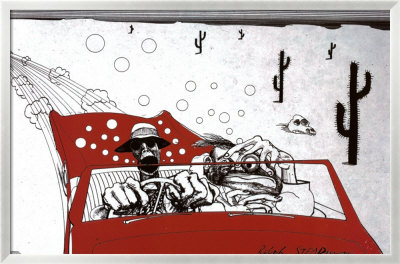
Book Review, 'Fear and Loathing in Las Vegas' by Hunter S. Thompson

“It’s interesting to note historically that downers came in with Nixon.”


Such is the distain that our author felt for the Nixon administration that he would make a point of writing this note. This is from the closing chapters of Hunter S. Thompson’s ‘Fear and Loathing in Las Vegas’, the now infamous, drug fuelled, post-modern adventure in search of the fabled American Dream with Raoul Duke and Dr. Gonzo. Like most patriotic concepts, the American dream is something that everyone knows about but cannot tell you what exactly it is. The war poets pointed this out to us almost a century ago and it still has yet to settle in. But enough of my opinions on that matter, lets stick to the book.

I had only watched Terry Gilliam’s film adaptation about a year previous to reading the book, and typical of a book put to film, many were telling me how the film was faithful but the book still better. So I became curious. What I came to realise was that Gilliam was going for a vivid visual interpretation of Thompson’s detailed descriptions. A perfect example is when ‘Duke’ takes a drop of fluid from a human adrenal gland. In the film, we see Duke (Johnny Depp) sweating furiously and seeing Dr.Gonzo (Benicio Del Toro) as a red devil. The intense heat and confusion of the moment are emphasised visually, whereas, in the book Thompson goes into detail about how he took one drop and began to feel hot and tense, took a second and his muscles began to lock up so tight that he could barely move, his teeth forced together as if they were a vice. The accounts Thompson gives of moments like these are striking and create immense mental images while reading: this is what Gilliam set out to capture in his colourful fashion.

In a generation such as ours that, I think it is fair to say, believes nothing but consumerism and has to fight for nothing (at least nothing worth fighting for, see lyrics from ‘The Coronas’ to flesh out my point), it is fascinating to read of, what Thompson considered, the death knell of a time that really meant something. His behaviour can lead one to think that he cares about little or nothing but Thompson, through Duke’s words, expresses the sadness that came when the 60’s were over. Even a casual reading of Howard Zinn’s ‘A People’s History of the United States’ can demonstrate just what an incredible period of upheaval that decade really was. Between black rights, women’s rights, tackling political corruption, environmentalism, Native American rights, prison reform, military reform, etc. The 60’s saw the USA change in an unprecedented way. The end of this time, coupled with the days of Nixon, and Tim Leary’s doctrine going nowhere, leads Thompson to lament and hark back to a better time just as that time is coming to an end.

What Gilliam missed, in my opinion, was the heavy social issues which the book deals with. Thompson creates an atmosphere of staleness and conformity against which Duke and Gonzo grind. A small statement about Las Vegas of the time, and a bigger statement about America of the time. All of which is written in masterful, down-to-earth language that, a few slang terms aside, is quite timeless.

As I already mentioned, our nameless generation (somehow ‘Generation Y’ just seems impotent) could benefit from reading about a time that truly did matter in many ways, some remembered, more forgotten. OK, I’ll admit, a mescaline powered rampage may not be the ideal package for that story, but why not?

“And that, I think, was the handle; that sense of inevitable victory over the forces of old and evil. Not in any mean or military sense, we didn’t need that. Our energy would simply prevail. So now, less than five years later, you can go up on a steep hill in Las Vegas and look West, and with the right kind of eyes you can almost see the high water mark - that place where the wave finally broke and rolled back.”


By Edward Gerard Brophy,
bornagainnihilist@gmail(dot)com

Thursday, June 23, 2011

Book Review -Isaac Asimov's 'Foundation'


Book Review,
Isaac Asimov’s ‘Foundation’

“Space! If only we were as confident about it as we pretend…”

If you yourself were living in the post-Earth galaxy which is the setting for the original book of Asimov’s Foundation Series, the above quote would be one of the most poignant things you would never hear. The words were spoken to no one by Salvor Hardin, the first Mayor of Terminus, a man that becomes an almost messianic character by the end of this astonishing book.

Isaac  Asimov’s Foundation first appeared as one complete novel in 1951 and is made up of five parts; The Psychohistorians, The Encylopedists, The Mayors, The Traders and The Merchant Princes. Each title describes the vital movers of their era at the outset of the book. Over the years, Asimov wrote a series of prequels and sequels so there exists a total of seven books in what is now known as The Foundation Series.

We open with mathematician Gaal Dornick’s trip to the planet Trantor where he is to work for the pioneering Hari Seldon. Seldon is the developer of a new branch of sociology called Psychohistory which is used to predict the path that populations will take with extraordinary accuracy. Seldon is getting old and has been subject to harassment from the rulers of Trantor for years because using his incredible new science he has predicted the downfall and decent into barbarism of the Galactic Empire which has stood for 12,000 years. Understandably, the government of Trantor, a key planet at the centre of this empire, is not happy to hear an influential man prophesising its doom and every covert effort is made to silence the ageing genius. Seldon needs a successor to carry out his plan for The Foundation. The Foundation is to be located on a small, unimportant planet at the periphery of the empire where 100,000 of all the best intellectuals of Trantor will be assembled to compile the Encyclopaedia Galactica (something I’m sure was parodied in The Hitchhikers Guide to the Galaxy). This holy grail of knowledge, if seen to its end, will cut the period of barbarism and war in the galaxy to a third of the time predicted by Seldon, and Terminus (the Foundation’s home) will be its Jerusalem.

From this dramatic beginning a series of events are set in motion covering the next century or so of the galaxy’s history. We see the set up of the Foundation, we see it mature into a planet with its own culture and identity, we see it face challenges both domestic and foreign. Yet Hari Seldon’s presence is never far away; when the Foundation was built he installed a chamber in which a small number of important people can gather to view a hologram which is set to play a pre-recorded message from Seldon just before any one of several crises which become known commonly as ‘Seldon Crises’. The image of an elderly Seldon in a wheelchair cannot tell those watching exactly what will happen for fear that doing so will upset the accuracy of the psychohistorical prediction. It can only announce that yes a crisis is coming and here is vaguely what to expect. It is up to the rulers of the time to interpret the message and do whatever must be done to protect the Foundation.

A long line of fascinating characters appear as we move through the years. The best of which has to be Salvor Hardin, the first mayor of Terminus. We meet Hardin during The Encyclopedist era as a young politician who is rising through the ranks of the quasi-government that sees to the needs of Terminus. He is the first to recognise that after some years, the people of Terminus are not just a collection of working academics any longer, they are a population, a people with two generations now and a slowly emerging identity of their own. They need to see their planet as a nation, not just a work station and as such, they need leaders, men and women who will protect the planet and its interests. Hardin goes to work. He has to be one of the sharpest and most cunning politicians in all science fiction and it is his foresight that establishes Terminus as a political and economic power to be reckoned with. In time, this tentative power will define Terminus almost more than Seldon’s original purpose.

The once encyclopaedists become the Mayors, from the Mayors spring the mysterious religion of ancestor worship that the missionaries spread to every corner of the former empire. After them come the Traders who’s keen sales pitch puts countless planets under the economic thumb of The Foundation. Finally, the best of these traders, who all seem to worship the wit and wisdom of Salvor Hardin, rise to the level of the Merchant Prices. At their top is Hober Mallow, a master trader with a head for politics to equal Hardin. By his time the galaxy has grown into something altogether new and sinister and the residue of the former empire rears its ugly head in the most unexpected way.

I will give away no more and give you my impression. This was a fascinating read from start to finish. The book, surprisingly, is mostly talk and discussion; this would leave many readers bored if it were any other book but not here! Asimov’s detailed descriptive writing and his vividly individual characters can keep even the quickest and least patient readers from getting lost in the myriad of new names, new planets and new political situations. There are plenty of action scenes to boot, make no mistake. A series of narrowly avoided battles define the last few chapters of the book and the evasion of such battles, and all out war in the bigger picture, is where Hari Seldon, Salvor Hardin and Hober Mallow are at their very best. They all posses a cunning nature that all men can admire.

I am inclined to think that the political nature of this book is what George Lucas wishes Star Wars could achieve but alas, he just had to waste time on Padme and Anacan Skywalker’s awkward love story. However, anyone thinking after reading this review that this book is nothing but politics and no hard sci-fi, don’t be alarmed, there is plenty of fantastic imagery and general weirdness to satisfy that all-too-familiar appetite for the wonderful. All things considered, absolutely excellent book and I’m heading down to the book shop in the mainstreet in Bray asap to scout around for the immediate sequel, Foundation and Empire.

According to Wikipedia, in 2008 it was announced that a film adaptation of Foundation is to be made with Roland Emmerich in the directorial driving seat. The following year Columbia Pictures bought the rights to the book and announced that the film would be made in 3D. In all honesty, I can’t say I’m excited by this news and the current wave of 3D movies is a forced fad to which I really do not give much credit. But you never know, could be something interesting.

Just a little end note: try reading sci-fi novels while on a plane going through turbulence. The book becomes more exciting and the turbulence becomes less stressful, I have experienced this twice in the past year, very interesting experiences!

Isaac Asimov’s ‘Foundation’
Rating: 9/10
By Edward Gerard Brophy
For Born Again Nihilist 2011

Thursday, March 31, 2011

"The Spurs Hurt , They Hurt Like Hell!"-Book Review -The Stars My Destination


“The Spurs Hurt. They Hurt Like Hell!”

Book Review of
'The Stars My Destination'
by Alfred Bester

FOYLE, GULLIVER – AS 128/127:006

EDUCATION: NONE
SKILLS: NONE
MERITS: NONE
RECOMMENDATIONS: NONE

This is a sci fi novel that I have heard used as the subject for dub music, jazz-rock fusion, stoner rock, 60's garage rock and others...Only a book that is a trip from start to finish could do so...and that's just what this is!

This is a book I was turned onto by a dude I used to work with called Cozzie, a fellow music and comic head, the two subjects around which our conversation invariably revolved. If it wasn't music it was film and if it wasn't film it was comics but one day in mid 2010 the cycle deviated a little to this 50's sci fi novel I had not previously heard of. 'The Stars My Destination' Cozzie maintained was the best sci fi story he had ever read. This development led to a few unscheduled minutes away from maintenance of the shopping centre to go to the book shop and find a copy of this hyped piece of work.

Later that day I went home about €12 poorer but had myself that copy of Alfred Bester's science fiction take on The Count of Monte Cristo!

Key to the entire story is the fictional phenomenon called 'Jaunting'. Without reciting the whole first chapter, suffice it to say jaunting is named after a scientist named Jaunte who discovers during an accident in which he was almost burned alive that man is capable of willing himself to teleportation. Jaunte is trapped behind glass and the area is aflame, he looks through the glass to the other side and wants nothing more than to be there instead of where he is now, then suddenly he is! Having disappeared  and reappeared some 15 feet from where he was. His fellow scientists extinguish the fire and immediately set to work to discover how this happened, the resulting realisation that this is not an isolated event and can be achieved again gives rise to the term 'Jaunting'.

The whole universe created in this book pivots on jaunting being a reality. Because humans can now transport themselves 1,000 miles at will, people are no longer bound to any one place. Jobs no longer depend on a proximity to your home. Homeless people now spend their time jaunting to disaster areas to loot and avoid the law, referred to as 'Jack-jaunters'. Those who cannot do it are the bottom rung of society and those in a job out of which they cannot jaunt are considered the least fortunate.

This is good old fashioned hard sci fi, stuff that demands a lot of your imagination but is the more rewarding because of it!

The book opens with Gully Foyle adrift in the remains of a wrecked spaceship on which he was simply a labourer. After several weeks of just barely surviving, living in a sealed closet in a spacesuit slowly running out of oxygen, a ship passes by. Foyle uses all his remaining strength to signal this ship yet it ignores him and continues on it's way. Foyle  in the most brutal rage imaginable, memorizes the name of the ship; “Vorga”, and vows to find it and destroy those who gave the order to leave him to die, should he survive at all.

At about one third of the way through the book we see Foyle in imprisoned in a place built in a deep system of caves known as “Gouffre Martel” (yes yes, he survives the spaceship, its not much of a spoiler, believe me!) Here he meets a companion, Jiz McQueen by way of their voices travelling naturally through the very rock to each other's cells, a prison myth that turns out to be a reality. Jiz is pivotal; she teaches Gully Foyle proper English and how to survive the prison. Here also is introduced the 'Blue Jaunte', a method of suicide where one jauntes into already occupied space, in this case the rock of the caves. A distinctive and terrible sound, like the sudden pop of a vacuum of air accompanies a blue jaunte. An interpretation featured at the end of my edition of this book offered the idea that the prison is the second of several wombs that gradually change Gully Foyle during our time with him, the first of these of course was the broken spaceship.

An old title for the book was 'Tyger Tyger', referring to a strange incident that results in Gully Foyle's face being tattooed with tiger stripes and the name Nomad on his forehead. This makes Foyle easy to identify, and given that he is being pursued by Saul Dagenham, this is of course problematic.

To give away any more characters or events would be to lessen the experience for you yourself so I will duly shut my qwerty trap and leave you to enjoy The Stars My Destination, learn to love and hate Gully Foyle in equal measures, and take an absolute trip throughout the entire closing chapter!!! An absolute trip!!!

“Gully Foyle is my name
And Terra is my nation
Deep space is my dwelling place
The stars my destination “

Edward Gerard Brophy
for Bornagainnihilist.

bornagainnihilist@gmail(dot)com